Thursday, April 26, 2012

V For Vendetta


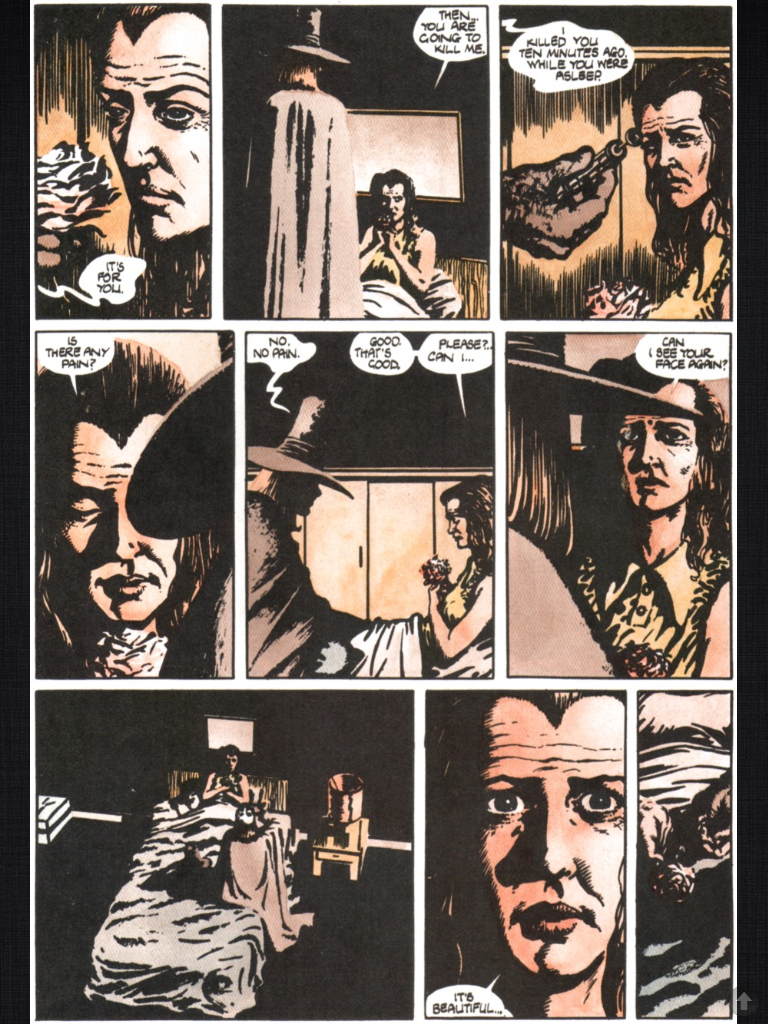
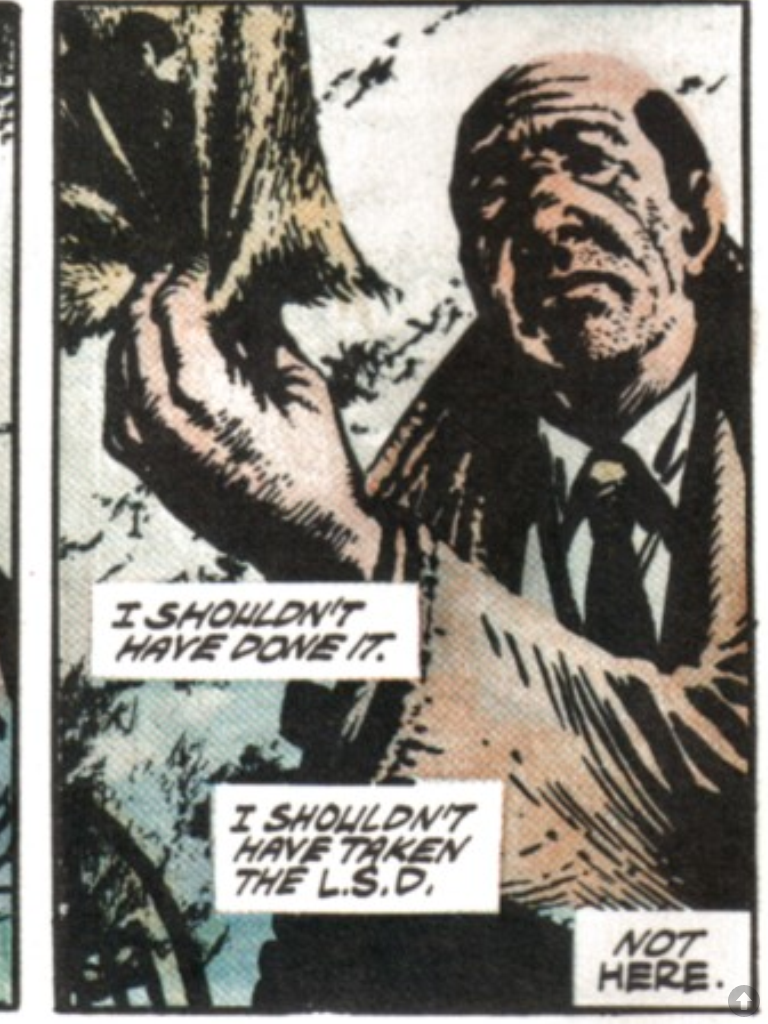
V for Vendetta, by Alan Moore, is a work which I initially found quite difficult to read due to its somewhat hackneyed construction in both the narrative and artistic realm (appropriately enough, the book's preface is essentially an apology by Moore regarding the beginning of the work's unsteady foundation).


The titular character, V, is a frank and astounding bundle of theatrics and domestic terrorism, a faceless avatar of an immortal idea. V's selfless and ceaseless devotion to his adopted ideal borders on pathological autism, made all the stranger by V's shadowy past and casual erudition. The lengths that V goes to to manipulate and "save" his initially hapless co-conspirator are obscene, going far beyond the boundaries of what we would typically think of as "emotional and physical abuse", all in the service of a hazily-defined crusade which, miraculously, resolves itself quite neatly at the end - and all according to a grand and inhuman masterwork of a plan.


The hand-off at the end of the tale, from V to girl, physically echoes his earlier assertion - that you can kill the man, but not the idea. "Ideas are bulletproof."


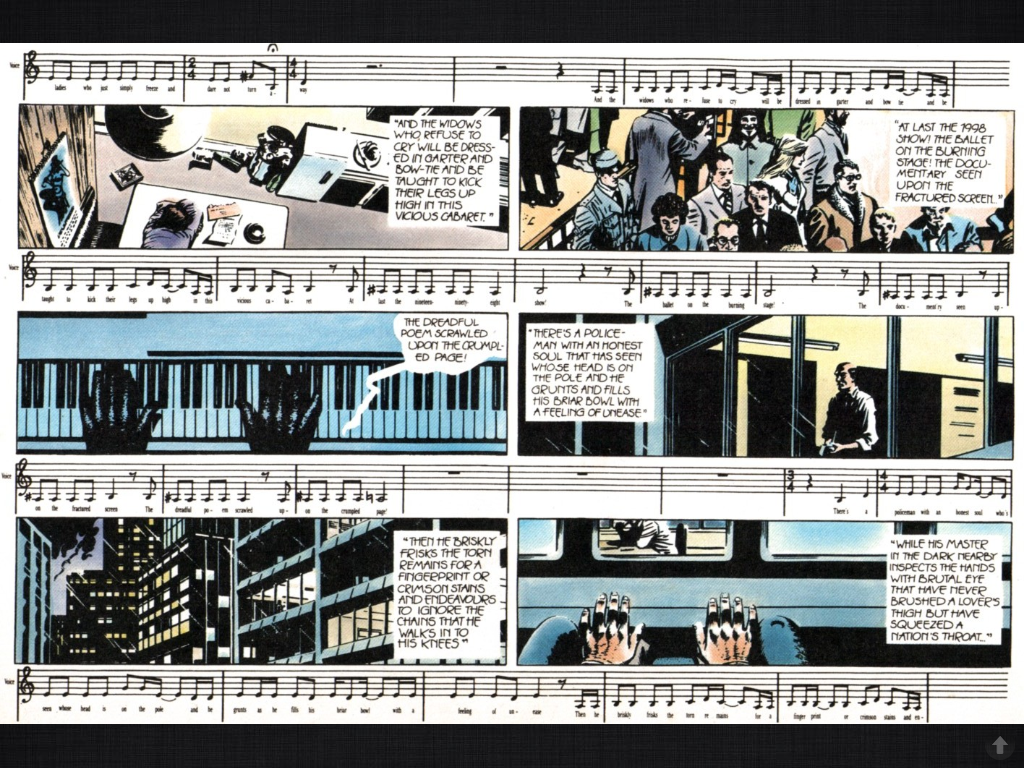
Moore's use of the visual "pun" elements and interweaving "unrelated" writing with strangely coincidental imagery is at its peak throughout several issues, however, a theme that he would return to in Watchmen.


 I have to say that while Moore is one of my favorite authors, I find myself a little perplexed at the popularity this particular work has enjoyed, as it is not particularly 'gripping', it is merely competent and very grim. I have a suspicion that the two aspects were what managed to set it apart back when it was published - much as how the Punisher enjoys the popularity it does for being something few comics at "its time" were.

Sandman


Sandman is a truly epic work, headed by Neil Gaiman and slavishly attended to by a team of shifting illustrators, comprising an unfortunately finite series of brilliant narrative. Monomythical in nature, Sandman follows the extra-corporeal adventures of Morpheus of The Endless, the administrator of Dream and gradual friend of the mortal realm.


The artwork in the series initial thrust is difficult to digest - which has led me, in the past, to rigorously caution newcomers to it all that "it gets better, I swear". The vaguely revamped version in Sandman Ultimate has only managed to slightly address this situation - though 'older' fans like myself seem to prefer the 'classic' look of the old and eye-searing initial volumes.


The themes that are woven throughout the series as a whole are sweeping in breadth and literally fantastic in nature - combining myths and legends from all corners of the earth and all eras of history, deftly metastasizing the disparate threads into a cohesive whole with the titular character firmly at the enter.


Morpheus finds himself tackling many things - the predations of humans, the intrigues of his fellow immortals and the gods that entertain their attentions, becoming the de facto owner of Hell, and eventually the struggle for his very existence as a being capable of change and perhaps even death (Death, meanwhile, being literally related by blood as Dream's sister).


The whole series is a sort of roller coaster ride that feels as much a tour of human mythological history as it does a clear narrative about a character who learns and lives despite being an immortal fixture in the fabric of our psychological universe.


This was (and is) easily one of the most important series I have read as both an artist and an individual, and has greatly informed the way I enjoy weaving together disparate characters and events in narratives - as well as 

Zombies VS Robots


Ashley Wood and Chris Ryall's "Zombies VS Robotss" is an interesting experiment in both art and narrative. With Wood's gritty and explosive art style dominating what thin narrative exists, it's quite easy to ignore the story and simply allow your eyes to lock themselves into autopilot for essentially the entire work.


In terms of technical arrangement, Wood doesn't merely break the rules of conventional comic book paneling, he burns them and tosses them into a ditch. Action spills across multiple, barely-implied  panel borders and pages, with lavishly-illustrated splash pages serving as pictorial exclamation points at the end of frenetic action sequences.


Other novel elements include ancillary 'definition' panels providing outside context for certain otherwise unexplained portions and characters in the story - a clear reversal of the "show, don't tell" maxim, something that comes across in the work as oddly refreshing.


The bulk of the work consists of the titular robots and zombies shredding one another into a fine pink and gunmetal mist, joined later by a tribe of lesbian zipatoned amazons, culminating in an apocalyptic battle that guarantees the theoretical destruction of all zombies, granting the heroes an ultimately temporary respite.


A truly intriguing and unique work, something that I found early on when I was first becoming acquainted with Mr. Wood. It really set the tone for the sort of work I felt at the time that I eventually wanted to be doing about two years ago (though that turned out quite differently - oh well). I felt that I learned (and I feel that I continue to learn) quite a great deal from Wood's flair for effortlessly dancing between the realms of narrative and image, and combining them in a way that is truly astounding.


Wednesday, February 29, 2012

Maus


I first read art spiegelman's "Maus" several years ago, when I was just beginning to realize that comics were actually entertaining and/or could be considered serious literature. This coincided roughly with reading the entirety of Sandman and Transmetropolitan, so my initial education in the medium was pretty illuminating. Like most people, I already knew that the holocaust sucked - erasing 11 million people in the service of hatred just isnt a pleasant chapter in the book of human accomplishments. I'd read Elie Wiesel's "Night" and seen the film "Life is Beautiful" in high school, but that had essentially been the extent of my education on the matter. 

"Maus" was something else. Where "Night" had been merely a window into an uncomfortable world I couldn't really come to grips with, and "Life is Beautiful" was primarily entertaining (well, as entertaining as the holocaust gets), Maus had felt real. It had impressed me so much that I bought copies to share with my father (and sharing comics with my father, I have found, has been a difficult proposition - one thing that art and I can share).

Ironic that I found a comic book about cartoon animals more real than these other efforts, but, it is what it is. The power of Maus, for me, had largely been a matter of its historical completion - it wasn't just a story about the holocaust, rather, it was also a story about the difficulty of telling a story. The vignettes of art's more recent struggle to identify with his father's past ones meshed perfectly with the story as told - it made me think, really think, about not just the story at-hand, but the nature of stories in general. No longer was the holocaust just an isolated event in history to me, but an ongoing effort to ascertain the whole structure of it…to a variety of ends, both personal (in both art's case, and mine) and historical (as to preserve the memory of its afflicted, the pain of its descendants, and the meaning it holds for everyone else who becomes aware of it). Self-identification with the events had metastasized somewhere between panels of cats and mice. I can't really ever hope to understand the holocaust, and when I read the bit where art expressed his own inability to fully appreciate what his father went through, it made me realize how ultimately hopeless my own quest to understand truly was. I feel both a deep sympathy for art's frustration and a disappointing spectre of personal, conscious defeat at the hands of time and history. Fuck.

I read Maus again recently, when I was on a comics-reading spree (driven both by this class and my recent passion for the medium), and the time between my initial reading and the more recent one had allowed me a heightened level of appreciation for what lurks inside its pages. As a result of this, I went looking for more of art's work; I read "Prisoner on the Planet Hell" and "In The Shadow of No Towers", both while doped up in the dentist's chair during the in-between stages of a root canal. This was also, coincidentally, my first real introduction to the comix genre. Is the confluence of those two things not somehow appropriate?

Something I've said about Maus from time to time is that t proves a comic doesn't require incredible artwork to function as an incredible piece of storytelling. Sometimes it just needs an incredible storyteller.

I've decided to not discuss my darker feelings about the specific events that art depicts; much has been written about the misery of history, and my thoughts about those are mine alone to bear.

Thank you, art spiegelman.

Thursday, January 19, 2012

Understanding Comics, etc.

As of this moment, I have only read up to Chapter 3 - but this book, being totally awesome, can't go unread forever. Actually, I suspect I'll read the entire thing by sometime tomorrow.

I have to say that I'm Not a comic book fan - that is, comics in their most popular incarnation (superheroes, etc) do not excite me as such. I've been a guarded devotee of some (a half-dozen) manga titles, and I've taken in the more important works from the west (Watchmen, Sandman, Transmet, etc), but I am Not a comic book fan.

I am the panels in the dead center of page 3 - "Sure, I realized that comic boks were usually crude, poorly-drawn, semiliterate, cheap, disposable kiddie fare - BUT - they don't HAVE to be!"

I found a lot of the history that Scott presents in the first chapter to be pretty rad stuff - it was interesting to see Ernst pop up in there, too - but I feel that I already 'knew' a lot of that, even if not literally, at least virtually. I have been aware of the nature of comics just by piecing through them.

One of the things that jumped out at me in these early chapters is how the nature of comics could perhaps only be explained by a comic (or at least most effectively). When Scott says a thing, and he shows you a thing, he says and shows them in literally the exact method they would appear in an actual comic - that is some powerful juju. His examples are both examples and not examples, appearing directly in-line and in-situ with the explanatory narrative as it happens. No diagrams. No breaks. Only comics.

Totally rad.